Why the BMF at 50 Is a Test of South Africa’s Economic Future

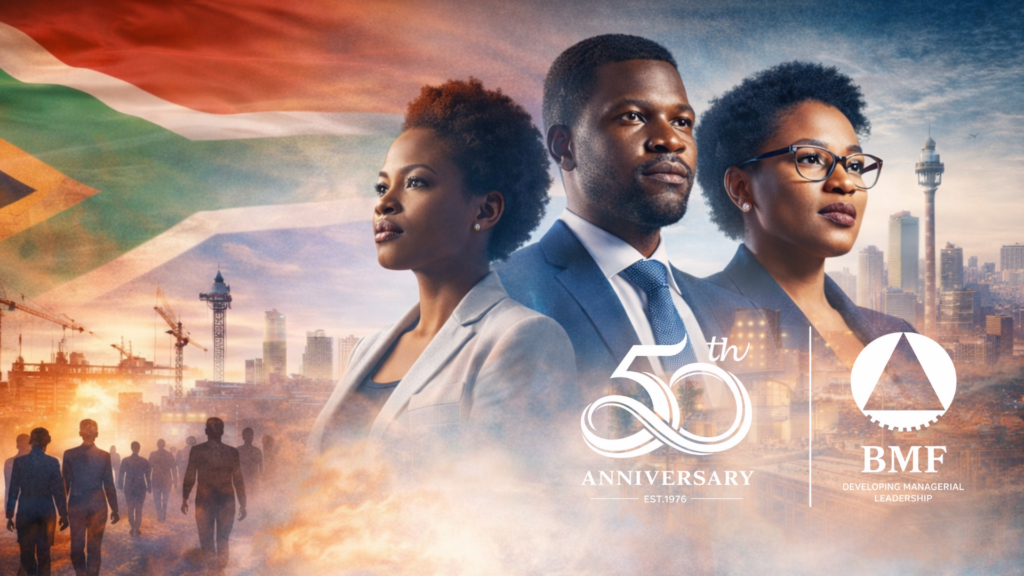
In a year where trust in institutions is brittle and transformation stands at a tipping point, the Black Management Forum’s 50th anniversary is more than a milestone it is a moment of national reflection and a litmus test for the future of economic justice in South Africa.
Founded in 1976, a year of fire and defiance, the BMF emerged in a country where exclusion from economic leadership was deliberate, enforced, and systemic. Its founding insight was unapologetic: political change without economic inclusion would leave South Africa’s liberation unfinished. Leadership, management, and ownership were never secondary concerns; they were the battleground.
Five decades later, that conviction has not expired. If anything, the necessity of structured, defended inclusion has become more urgent as the frameworks that underpin South Africa’s transformation project come under renewed pressure. Economic inequality remains among the world’s most extreme. Trust in government and the private sector has frayed. For many, particularly young Black South Africans, transformation feels stalled or worse, even betrayed. The question is not simply whether the BMF has lasted 50 years. The question is whether, in this moment of national reckoning, it can still lead.
The Relevance Test in a Changing Landscape
In 2026, South Africa stands at a crossroads defined by political fluidity, uneven economic recovery, and a growing impatience, particularly among younger generations with symbolism that does not translate into lived improvement.
We see it in the discourse, debates on employment equity reduced to technical compliance; transformation codes applied without confronting who holds capital or makes decisions; social compacts built on consensus, not courage. Representation has expanded, yet authority remains concentrated. Growth has returned in pockets, yet participation in value creation remains limited. There is a disconnect between vision and outcomes, policy and practice. And it is within this tension that the BMF’s relevance is tested.
The organisation’s strength lies in its dual role. The BMF carries the institutional memory of how exclusion was engineered from boardrooms to policies while engaging directly with the contemporary realities of leadership, governance, and reform. This allows it to speak with credibility when transformation is contested, diluted, or reframed, and to insist that inclusion cannot be deferred to market forces or reduced to an administrative exercise. In a climate of fragile trust and rising expectations, that stance is not optional, it is essential.
And yet, relevance today cannot be inherited. It must be earned, in how we respond to shifting power dynamics, generational expectations, and the question many are now asking: “Transformation, for whom?”
Policy, Power and the Future of Inclusion
In this year’s State of the Nation Address and national Budget, South Africans will listen closely not just for promises, but for priorities. Who gets to set the policy agenda? Whose needs are centered? And whose future is being financed?
The answers to these questions are not abstract. They define whether transformation advances or retreats. This is where the BMF must assert its next-generation mandate, not only as a commentator on policy, but as a force that shapes it. The next phase of economic inclusion must go beyond increasing participation; it must demand reallocation of influence, clarity on outcomes, and accountability from institutions that have mastered the language of transformation without disrupting its terms.
This means reasserting the link between equity and growth. It means challenging the assumption that markets will self-correct towards justice. And it means equipping a new generation of Black leaders in business, government, and civil society with the tools, networks, and political will to lead differently.
A Vision for the Next Fifty Years
At 50, the BMF is not pausing to commemorate a legacy; it is stepping forward to shape what comes next. The next frontier of transformation will not be won through representation alone. It will be won by those who can shift architecture of decision-making, capital flows, accountability mechanisms, and strategic ownership. It will require leaders who move beyond occupying space to reshaping institutions. Who not only steward capital but also leverage it for systemic inclusion. Who refuse to be proxies and instead drive reform that delivers progress, not platitudes.
This is not a technical task. It is political. It is generational. And it will be hard.
The BMF’s challenge is therefore more exacting than before. It must develop leadership equal to complexity. It must convene conversations others avoid — not for provocation’s sake, but to confront uncomfortable truths: that Black professionals can rise in institutions that still resist transformation; that compliance can coexist with exclusion; that metrics can obscure meaning.
Above all, the BMF must remain clear: inclusion is not a concession. It is a prerequisite for legitimacy, for stability, and for a South African economy that can thrive beyond elite enclaves.
From Custodian to Catalyst
As the Forum marks this milestone, it does so not as a custodian of legacy, but as a catalyst for what’s next. That means anchoring its work in the lived experiences of Black professionals and business owners from township entrepreneurs blocked by procurement red tape to executives navigating boardrooms still resistant to structural change.
It also means building coalitions across provinces, industries, and generations to ensure that transformation is not the task of the few, but the demand of the many. And it requires rejecting the temptation to trade vision for access or clarity for comfort.
South Africa does not need more organizations that manage perception. It needs institutions that move the needle.
About the Author
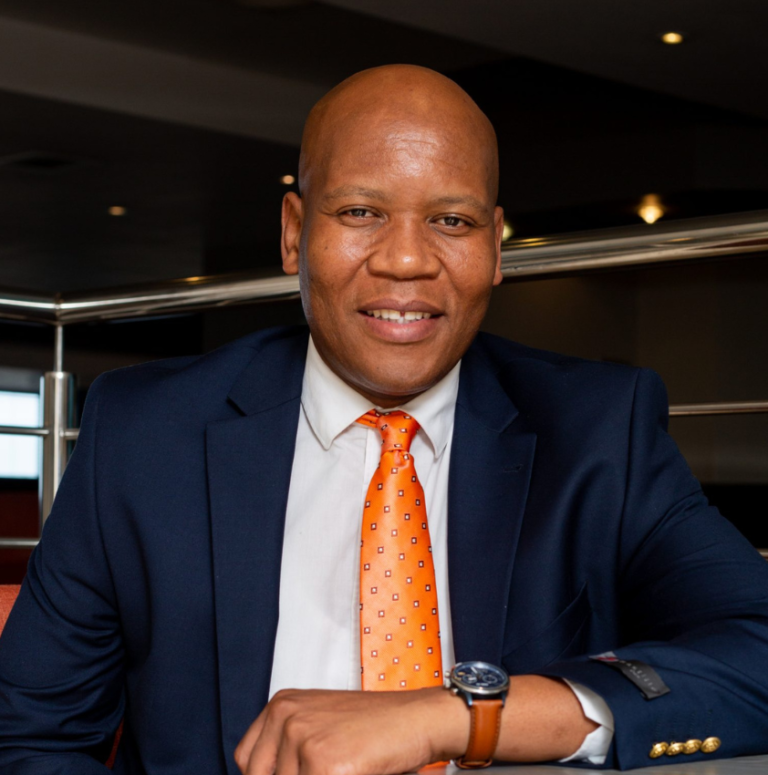
Dr BJ Mthembu (PhDs-UFH and Florida)
Eastern Cape Provincial Chairperson and Member of the Board of Directors of the Black Management Forum (BMF).



Responses